Arizona Monsoon RV Safety: A Pre-Storm and Roadside Checklist
🌟 Special Offers from Main Street RV
📞 Call 480-626-8845 – NO CITY SALES TAX!
🔋 Solar & Lithium Installs
Upgrade your RV with sustainable, off-grid power solutions.
🚐 Free RV Consignment
Let us help you sell your RV—no consignment fees!
⭐ Love Your Experience?
Leave us a Google review—we appreciate your feedback!
📍 Visit or Call Today
Stop by or call to schedule a viewing.
Your next adventure starts here!

Arizona monsoon weather has a flair for dramatic entrances.
One minute, the campground is holding a perfectly ordinary conversation about camp chairs. The next, the sky has turned the color of a bruised peach, the wind has found every unsecured tablecloth in the county, and somebody’s empty dog bowl is headed toward New Mexico.
The humor stops, however, when an RV is caught in strong wind, blowing dust, lightning, or fast-moving floodwater. Monsoon storms can develop quickly, and an RV presents more surface area—and more exterior equipment—than an ordinary passenger vehicle.
A little preparation protects the rig, but more importantly, it protects the people and pets inside it.
Safety note: This guide is a general preparation checklist, not a substitute for the instructions supplied by your RV, chassis, tire, appliance, battery, generator, awning, or propane-system manufacturer. Have electrical, propane, structural, roof, towing, and code-sensitive problems inspected by qualified professionals.
1. Check the forecast before the stabilizers come down
Monsoon planning starts before you move the RV or choose a campsite.
Check the National Weather Service forecast for your departure point, destination, and route. Pay attention to:
- Dust Storm Warnings
- Severe Thunderstorm Watches and Warnings
- Flash Flood Watches and Warnings
- Excessive Heat products
- Strong-wind forecasts
A storm does not need to be directly overhead to cause trouble. Rain falling miles away or upstream can send water into a wash that looked dry when you arrived. The National Park Service warns that monsoon flooding can rise downstream even when the parent thunderstorm is some distance away. It also advises campers not to park or camp near streams and washes during threatening conditions. See the National Park Service monsoon guidance.
If the forecast looks rough, changing the departure time is not cowardice. It is the RV equivalent of looking at a ladder in high wind and deciding today is an excellent day to reorganize a drawer instead.
2. Bring every outdoor item home
Before the wind arrives, walk completely around the campsite.
Retract or secure:
- Patio and window awnings
- Camp chairs and folding tables
- Outdoor rugs
- Grills and portable cooking equipment
- Pet pens, tie-outs, bowls, and toys
- Trash containers
- Flags and lightweight decorations
- Portable solar panels
- Bicycles and covers
- Satellite equipment
- Sewer-hose supports and loose utility accessories
Follow the manufacturer’s directions for awnings, slide rooms, leveling systems, and exterior accessories. An awning can become an expensive sail long before the weather feels severe at ground level.
Do not climb onto the roof with wind or lightning nearby. If something on the roof needs attention and it cannot be handled safely from the ground, move to shelter and arrange a professional inspection later.
A brief composite campground scene
The following is a fictional composite, included for humor—not a real customer story.
A camper notices a wall of dust approaching and announces, “I’m ready. I put the chairs away.”
His spouse points silently toward a plastic flamingo still staked beside the steps.
The flamingo, having reviewed the wind direction, appears ready to pursue a new life in Tempe.
They bring it inside.
The lesson is simple: finish the whole walk-around, even after you think you are done.
3. Inspect the roofline, seals, awning, and slide toppers
Water intrusion often announces itself quietly—a damp corner, a discolored ceiling panel, or a mysterious soft spot—then submits a much larger invoice later.
From the ground, look for:
- Loose trim or molding
- Sealant that appears cracked, separated, or missing
- Awning fabric pulling away from its track
- Damaged slide toppers
- Loose vent covers or exterior access doors
- Branch damage
- Previous leak stains inside cabinets or along walls
- Water collecting where it normally does not
Roof materials and sealants are not interchangeable. Do not apply a random tube of household caulk simply because the label contains the reassuring word “waterproof.” Use only products approved for the RV’s roof and wall materials, and follow the manufacturer’s preparation and application instructions.
If you find roof damage, structural movement, widespread seal failure, or signs of an active leak, schedule qualified service. The goal is to fix the water path, not merely decorate it with more sealant.
4. Give the tires a cold inspection
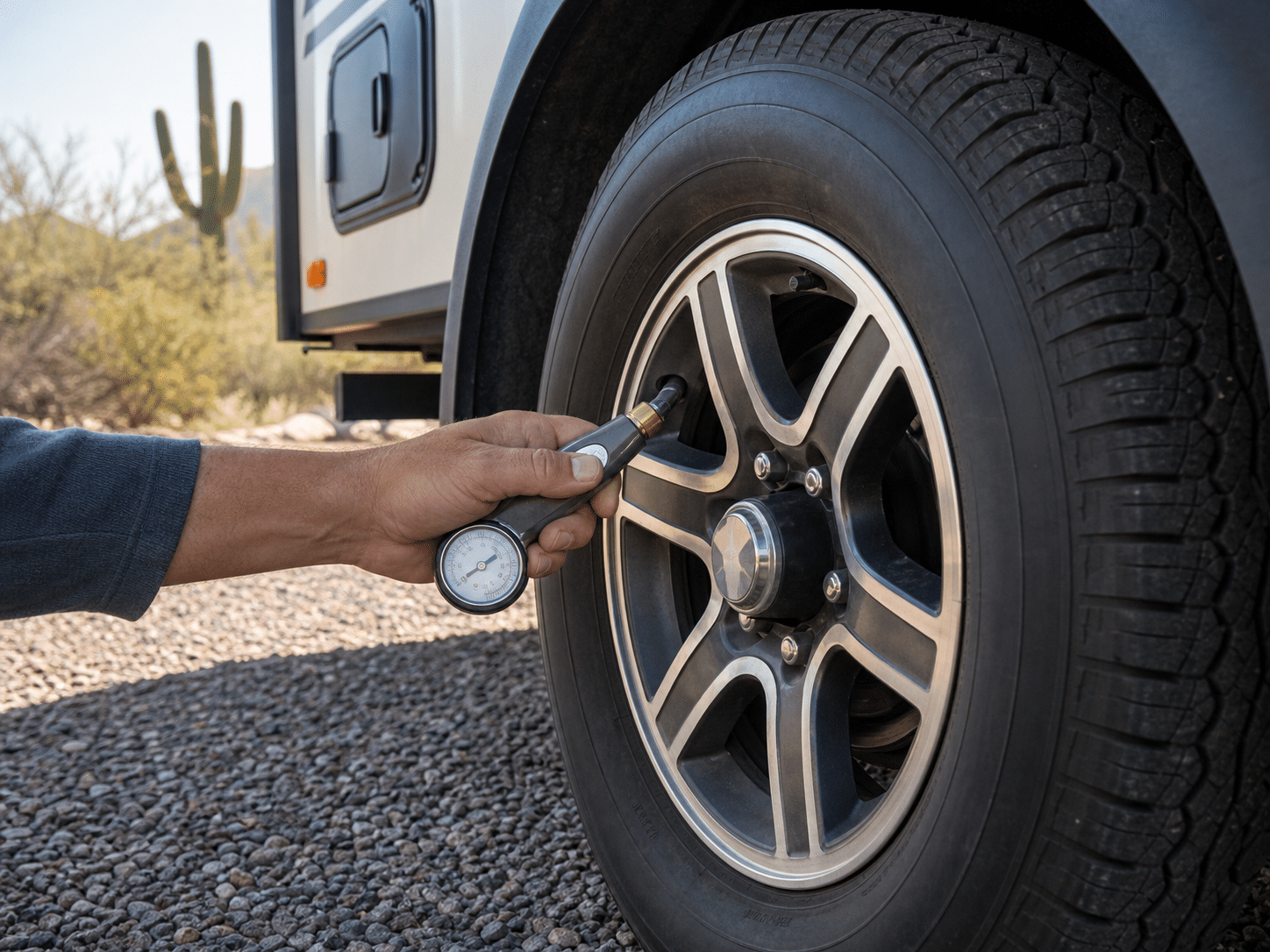
Arizona heat is hard on tires, and sustained high temperatures can contribute to deterioration. The National Highway Traffic Safety Administration recommends checking tire pressure when tires are cold—generally before driving or after the vehicle has been parked for at least three hours.
Use the inflation pressure specified by the vehicle or RV manufacturer, normally found on the certification or tire-information label and in the owner’s documentation. The number molded into the tire sidewall is not automatically the correct operating pressure for the loaded RV.
Check:
- Inflation pressure on every road tire
- The spare, if equipped
- Tread and sidewalls
- Cracks, cuts, bulges, exposed material, or unusual wear
- Valve stems and accessible valve extensions
- Signs that a tire has rubbed another component
- Tire age and replacement guidance from the tire and RV manufacturers
Do not release air simply because a tire’s pressure rises after driving; warm tires normally show a higher reading. NHTSA specifically recommends using a cold reading for accuracy. Read the NHTSA TireWise guidance.
Tire condition is not the place for optimism. If you see a bulge, separation, significant cracking, impact damage, or unexplained pressure loss, have the tire inspected before traveling.
5. Test alarms and treat propane with respect
Before a trip—and according to each device manufacturer’s testing schedule—verify the operation and replacement status of the RV’s:
- Smoke alarms
- Carbon-monoxide alarms
- Propane-gas alarms
- Fire extinguisher
The National Fire Protection Association recommends working smoke alarms and carbon-monoxide protection in RVs, along with careful use of generators and propane appliances. Review the NFPA RV fire-safety guidance.
Have damaged propane components, persistent alarm conditions, suspected leaks, or appliance problems evaluated by a qualified RV propane technician. Do not search for a leak with a flame. Never use an oven or range to heat the RV, and do not run a generator where exhaust can enter your RV or a neighboring campsite.
If you smell propane, hear leaking gas, or a propane alarm activates, follow the emergency instructions supplied with your RV and detector. Avoid operating switches or creating ignition sources, leave the RV, move a safe distance away, and contact emergency services or a qualified professional as appropriate.
6. Don’t improvise with electrical protection
Storm preparation is also a good moment to look at the power connection.
From a safe position, check for:
- A damaged shore-power cord
- Loose, scorched, melted, or discolored plugs
- An unusually hot connection
- Water around the pedestal or connection point
- Improvised adapters or undersized extension cords
- Warning lights or fault indications on approved protection equipment
Disconnect only as directed by the campground, RV manufacturer, and electrical-equipment instructions. Never handle electrical connections while standing in water. Do not open, modify, or repair a pedestal yourself.
Battery charging and storage requirements vary by battery chemistry and installation. Follow the battery, charger, and RV manufacturers’ instructions. Swollen cases, unusual heat, odor, leakage, damaged cables, or persistent charging faults require professional attention.
7. Do not camp in a wash—even if it has excellent ambience
A dry wash can be scenic, level, and remarkably persuasive. It is still a drainage channel.
Avoid parking or camping:
- In dry washes
- At the bottom of narrow canyons
- Beside a stream during threatening weather
- In low spots that collect runoff
- Where the only exit crosses a flood-prone dip
- Beneath obviously damaged limbs or unstable trees
Never drive around a barricade or enter a flooded roadway. Water can conceal a washed-out road surface, and its depth and force are difficult to judge from the driver’s seat.
The National Weather Service’s monsoon guidance is blunt for good reason: avoid low-water crossings, do not attempt to cross flowing water, and move to higher ground when flooding threatens. See the National Weather Service monsoon safety guidance.
8. If a dust storm reaches the road, get completely off the pavement
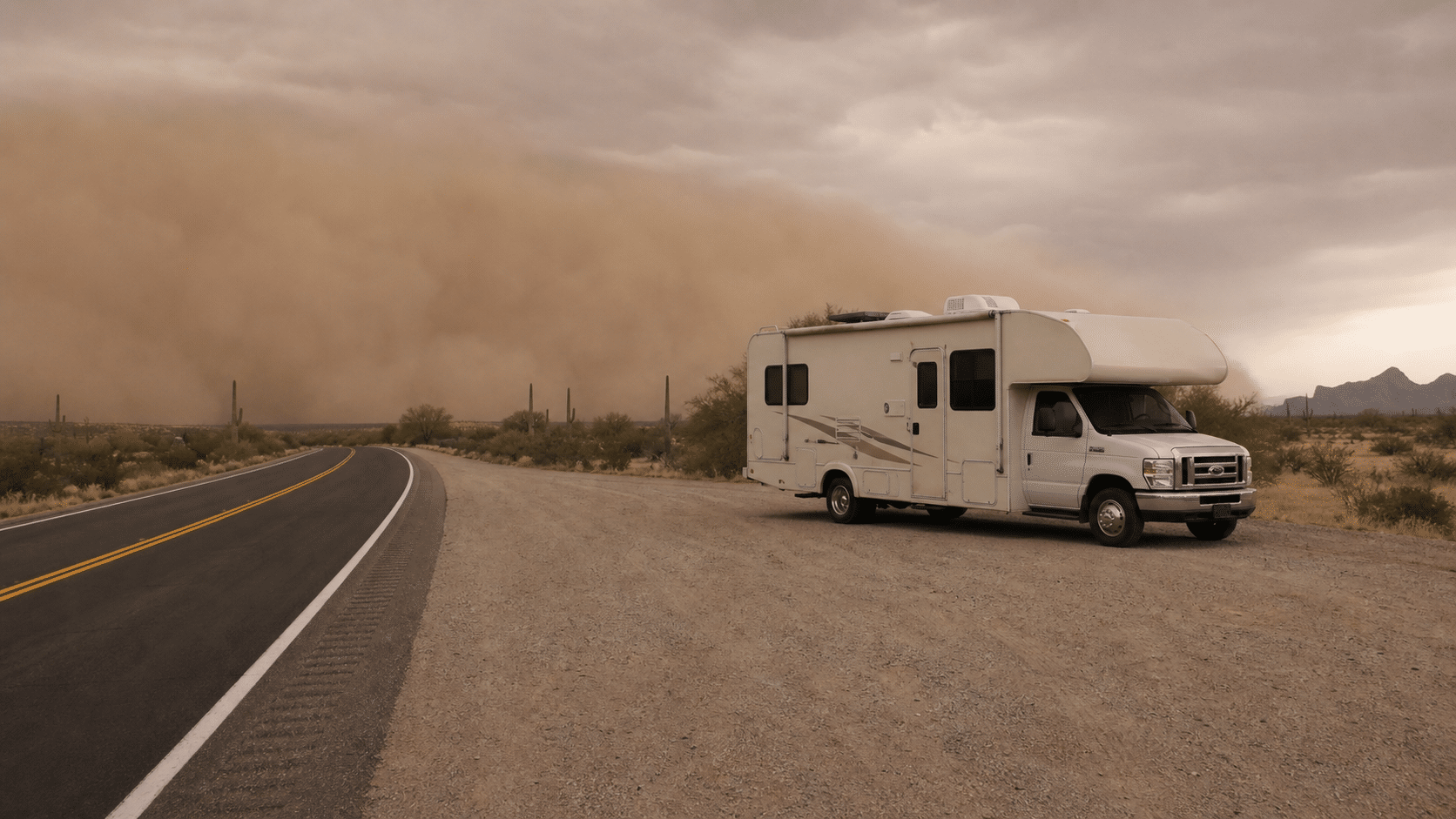
The safest choice is to avoid entering dense blowing dust when possible.
If dust overtakes you and you can safely leave the traveled roadway, the National Weather Service advises:
- Pull as far off the pavement as possible.
- Stop.
- Put the vehicle in park and set the parking brake.
- Turn off all lights.
- Take your foot off the brake so the brake lights are not illuminated.
- Remain belted in the vehicle and wait for conditions to improve.
Why turn off the lights? Drivers behind you may mistakenly follow visible taillights off the roadway and strike your stopped vehicle. Never stop in an active travel lane. Review the National Weather Service dust-storm guidance.
For an RV, “as far off as possible” also means choosing ground capable of supporting the vehicle. A soft shoulder may not safely hold a heavy motorhome or trailer. Slow early, leave generous space, and avoid abrupt steering or braking.
9. After the storm, perform another complete walk-around
Calm weather does not automatically mean the RV is ready to roll.
Check for:
- Branches or debris on the roof
- Awning and topper damage
- Water intrusion
- Loose trim, vents, antennas, or access doors
- Damage near tires, wheels, brakes, suspension, or hitch equipment
- Mud, erosion, or soft ground around tires and stabilizers
- Debris blocking appliance vents
- Changes in shore-power equipment
- Unusual odors or active alarms
- Items underneath the RV that may have shifted
Do not crawl under an RV supported only by leveling or stabilizing equipment. Do not touch fallen power lines or anything in contact with them.
If water has entered electrical equipment, the propane system has been struck or damaged, the roof has been penetrated, or towing components appear to have moved, leave the system off and arrange an inspection.
The ten-minute monsoon checklist
Before the storm
- Check current warnings and the route forecast.
- Move away from washes and low ground.
- Retract awnings according to their instructions.
- Bring in chairs, rugs, pet gear, grills, and portable panels.
- Close and latch windows, vents, compartments, and access doors.
- Look for loose roofline components from the ground.
- Confirm alarms are operating.
- Keep people and pets inside a safe shelter.
- Avoid roof work, propane repairs, and electrical improvisation.
- Decide now where you will shelter or pull over if conditions worsen.
Before driving afterward
- Inspect tires and towing components.
- Look above, below, and around the entire RV.
- Check for leaks and active alarms.
- Confirm the route is open.
- When in doubt, wait or request professional service.
A prepared RV is a much more relaxing RV
Monsoon preparation is not about fearing every dark cloud over the Superstitions. It is about removing the small, preventable problems before the wind finds them.
A careful walk-around, a reliable forecast, healthy tires, working alarms, and a willingness to wait out bad conditions will do more for a pleasant trip than almost any gadget in the storage bay.
And please bring in the flamingo.
If your inspection uncovers damaged seals, questionable tires, electrical concerns, an awning problem, or another item that needs trained attention, Main Street RV’s team in Apache Junction can help you determine the appropriate next step. Visit the RV service department, browse RV parts and accessories, or submit a service request.